


Thuja is a genus of conifer in the cypress family that only has five extant species, but a couple of them are pretty interesting, so I thought we’d check them out this month. Confers hit the plant scene during the triassic (250-200 million years ago), but the earliest Thuja fossil we have, T. polaris, doesn’t show up until the Paleocene (66-56 million years ago). But that’s just conifers, the earliest plants are probably around 700 million years old. Just a periodic reminder that plants have been here much, much longer than us. The earliest hominids date back to approximately 4.5 million years ago, and modern humans have only been around for about 300,000 years. Respect your elders is all I’m saying. Life on Earth would not be sustainable without them…. But they could, also, theoretically, one day start producing a little too much oxygen and we’d all die. Or slightly less oxygen… and we’d all die. Respect.


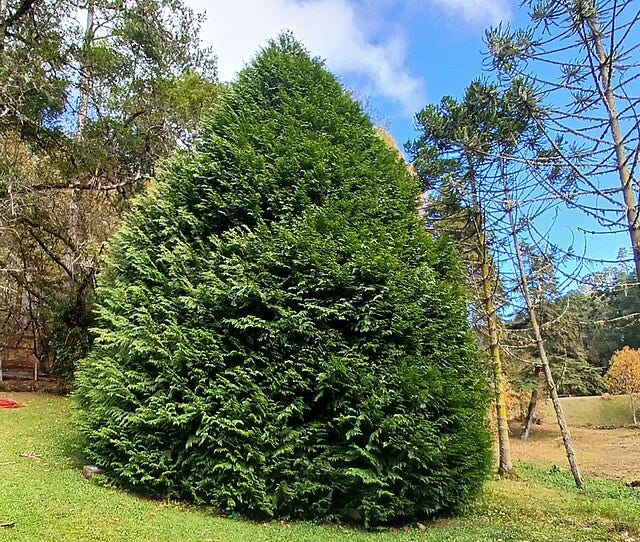
The two most salient species of Thuja are T. occidenatlis and T. plicata, the northern white cedar and western redcedar, respectively. Neither are cedars, but plant names are wily, you kind of have to accept it. Both trees are also known as arborvitae, or tree of life. White-cedar is native to the northeast coast of the US and redcedar is native to the Pacific Northwest.
We’ll start with redcedar, it’s a much bigger species, reaching heights of 230 feet. So big, in fact that it is used by The First Nations of the Pacific Northwest to make totem poles. Redcedar is known as the Tree of Life because it is used to furnish so many other aspects of indigenous life, everything from bowls and utensils, to baskets, houses, canoes, to ceremonial objects. Redcedar bark is used for clothing, mats, rope, and other soft items. Bark is only harvested from a tree once as stripping too much bark will kill it. According to The Gymnosperm Database, before Europeans came to the Americas, the trees were never cut down, only trees that fell on their own, or planks cut from living trees were used. Archeological evidence suggests that redcedar has been in use by indigenous people for at least 8000 years. (For anyone counting, that’s WAY before white people came to North America… in fact, if you really want to get technical, there are fossilized footprints of indigenous people in White Sands, Arizona that have been dated to around 21,000 and 23,000 years ago… again, way before the white people)
A Coast Salish story says that Great Spirit created the redcedar to honor the spirit of a man who always helped his neighbors, “When he dies and where he is buried, a cedar tree will grow and be useful to the people -- the roots for baskets, the bark for clothing, the wood for shelter.” Really digging this whole vibe.


On the other side of the country we have Thuja occidentalis, or Northern White-Cedar, or Nookomis Giizhik in Ojibwe, which means Grandmother Cedar. As you might imagine, this tree is treated with care and respect by not only the Anishinaabe, but by other indigenous people in the North East as well. White-cedar is used less for building and crafting, and more for medicinal purposes. Its leaves are high in vitamin C, which is how it became known as arborvitae. In 1536 French explorer Jacques Cartier learned from the Iroquois that it could be used to treat scurvy. Scurvy is, of course, a vitamin C deficiency that once plagued sailors unable to take fresh fruit on long sea voyages. Early symptoms of scurvy are fatigue and soreness, but as it progresses bleeding, gum-disease, inability to heal wounds, personality changes, and death can occur. You can actually make a tea out of the leaves, but I have to warn you, the leaves contain Thujone, which is also found in wormwood and is what allegedly made Absinthe cause insanity. Thujone is a toxin and can kill you. Pregnant women should definitely not drink white-cedar tea and everyone else should drink in moderation. That said, Thuja is also commonly found in scent oils and hair oils, and yes, there is Thuja Gin.
One of the oldest white-cedar trees is called the Manidoo-giizhikens, or Little Spirit Cedar Tree, and grows on the shore of Lake Superior in Minnesota. The tree is sacred to the Ojibwe First Nations who frequently leave it offerings of tobacco in return for safe travels on the lake. The tree is also known as the Witch Tree and I tracked down the origin story of that name… it’s not great. In 1922 artist Dewey Albinson painted the tree and then had this completely disrespectful and false thing to say about it:
“incredible that this wind-twisted old cedar can have braved the elements for perhaps four hundred years. In the old days, the Indians would portage across the point back to a gully to avoid passing the tree and the Evil Spirit that lives in it and dared only approach in large groups, drumming and singing, and bearing gifts of tobacco to appease the Evil Spirit.”

Yeah, while I love a witch tree, this one ain’t it. The Ojibwe revere cedar trees, this one especially. In fact the tree is off limits to sightseers and can only be visited with an Ojibwe guide. It’s odd/disturbing how readily white Americans will monsterfy things sacred to Indigenous People isn’t it? Kind of a horror pet peeve of mine…. Like make up your own stories you unimaginative shmucks.
Anyway.
I’m going to leave you with a painting of the tree by Ojibwe artist George Morrison and this soothing video about weaving cedar mats by Little Traverse Bay Bands of Odawa Indians Tribal Historic Preservation Office.


Hey there! Here’s how plant horror in the coven works:
First week of the month - The Lab (that’s this post!) - Free for everyone.
Second week of the month - The Witch Lab (a short, horror piece from a plant witch’s journal detailing one of her experiences helping (I use the term loosely) a client using the featured plant of the month - New episodes are free! The back catalogue is going to remain paywalled largely because un-paywalling it is time consuming and I am busy doing horrifying things.
Third week of the month - The Grim Grimoire (an entry from The Witch’s spell book detailing how she uses this plant for her dark magic including spells, chants, recipes, instructions, and more). The text version of this will be free, but a digital zine version will go out to paid subscribers. The back catalogue will remain paywalled for the reason stated above.
Fourth week of the month - 100% Plant-Based Horror story featuring the month’s plant. These are longer stories that include everything from ghosts, to parasites, aliens, experimental supplements, monster trucks, extinct species, serial killers, and more! - Paid subscribers only, here’s a freebie you can read to check it out!
Love a geeky, nerdy piece with a witchcraft twist. Especially since, where I'm from, this tree grows e v e r y w h e r e.
wonderful! 🫠
thank you ... fascinating and uplifting.
did you read my story about gitchee manitoo ...TREES feature heavily... "True to his spirit" it's called.