

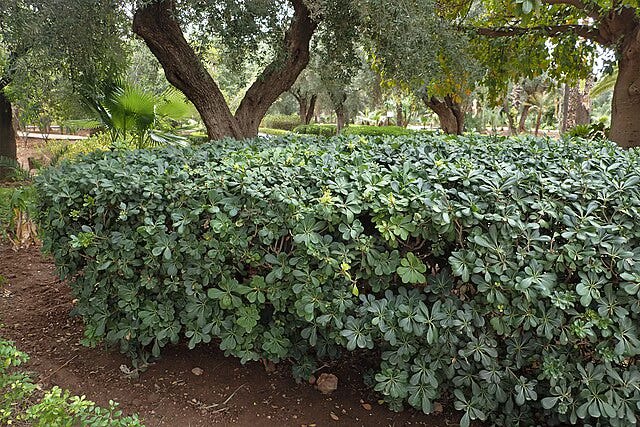
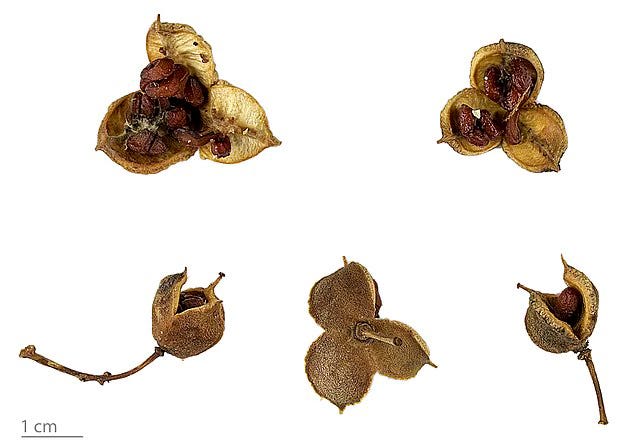
Native to Japan, China, and Korea, Pittosporum tobira is also known as other things, but most weirdly, Japanese cheesewood, for which I could not find an explanation, but I do have a theory, though more about that later. Its scientific name Pittosporum comes from the Greek pitta meaning ‘pitch’ and sporos meaning ‘seed’ because its seeds are covered in a sticky resin. The seeds are a favorite of birds and it’s likely that the resin helps with distribution. In fact these plants are considered invasive in many places because they escape cultivation so easily.
The second part of its name, tobira comes from the Japanese tobira no ki which means ’door tree’. Here we’ll take a quick detour to Japan to help explain this curious name. Every year in early February the Japanese celebrate Setsubun, which literally means ‘seasonal division’ and celebrates the day before the first day of spring on the Japanese calendar. During this time the spirit world is thought to be very close to the physical world. Rituals are performed to drive out evil spirits or any bad fortune that is hanging around from the previous year. Some rituals include mamemaki or ‘bean scattering’ in which roasted soybeans are thrown out the door or at a family member wearing an oni mask while shouting “Devils out! Fortune in!” Sounds fun idk... also I’ve never had roasted soybeans but they sound delicious.

Another custom is hanging roasted sardine heads with either Pittosporum tobira, because it apparently stinks when cut which will drive away bad spirits, or holly, which will frighten bad spirits away with its thorns, over your door, hence the name ‘door tree.’
So this bad smell, I should note that P. tobira only stinks when cut, presumably to discourage predation. Although it is still eaten by the sika deer. I have one of these trees out behind my apartment and two inside and a suspicion that the smell might be what puts the cheese in cheesewood :( but I can’t cut a tree for something so silly. So I’m going to pretend that P. tobira smells like Roqueofort and sika deer like cheese.

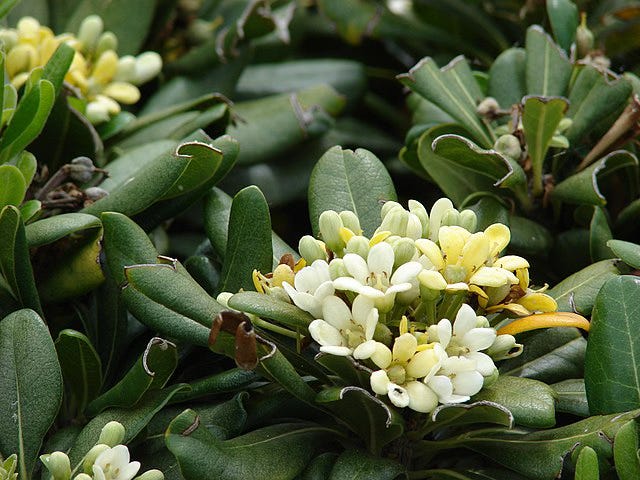
Now, cheese-scented wood aside, another of P. tobira’s common names is the mock orange because its creamy white blossoms smell similar to orange blossoms. This I can confirm, they smell incredible in the spring.
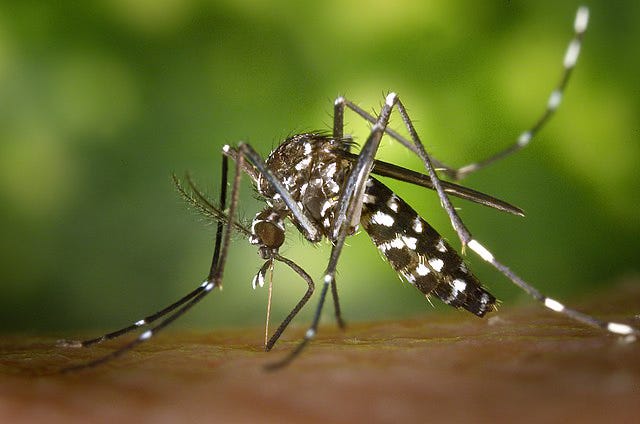
Possibly because it’s inedible and smells bad when cut, I couldn’t find any folk medicine uses for this plant, but in science Pittosporum tobira has been shown to protect against glutamate-induced neurotoxicity, which is when the neurotransmitter glutamate overstimulates neurons and causes cell death, which in turn can lead to neurodegenerative diseases. It has also shown antibacterial activity, cytoprotective properties against various forms of cancer, and antioxidant properties. A 2019 study published in The Florida Entomologist stated that the mosquito Aedes albopictus laid fewer eggs on Pittosporum tobira than on other plants in the study.
The top 5 plant species that resulted in the most egg production were as fol-lows: A. grandiflora, L. chinense, V. odoratissimum, E. japonicas, and P. fraseri. Mosquitoes exposed to P. fortuneana, P. tobira, and L. quihoui produced significantly fewer eggs per female than mosquitoes from other groups.
Aedes albopictus aka the tiger mosquito, is a known vector for yellow fever, dengue fever, Chikungunya fever, and usutu virus in humans. Also, it’s a vector for heartworm in dogs and cats. Fewer of these monsters is definitely a good thing, I say plant more P. tobira.
These plants are often propagated from cuttings, but they’re also really easy to grow from seed. I have two that I grew from seeds from the tree behind my building. The seeds were really sticky when I found the open pod on the ground, but I just popped them in the dirt that way and put the pots under a grow light. They grow pretty quickly, look cool, and take a fair amount of neglect. Probably two of my favorite plants.
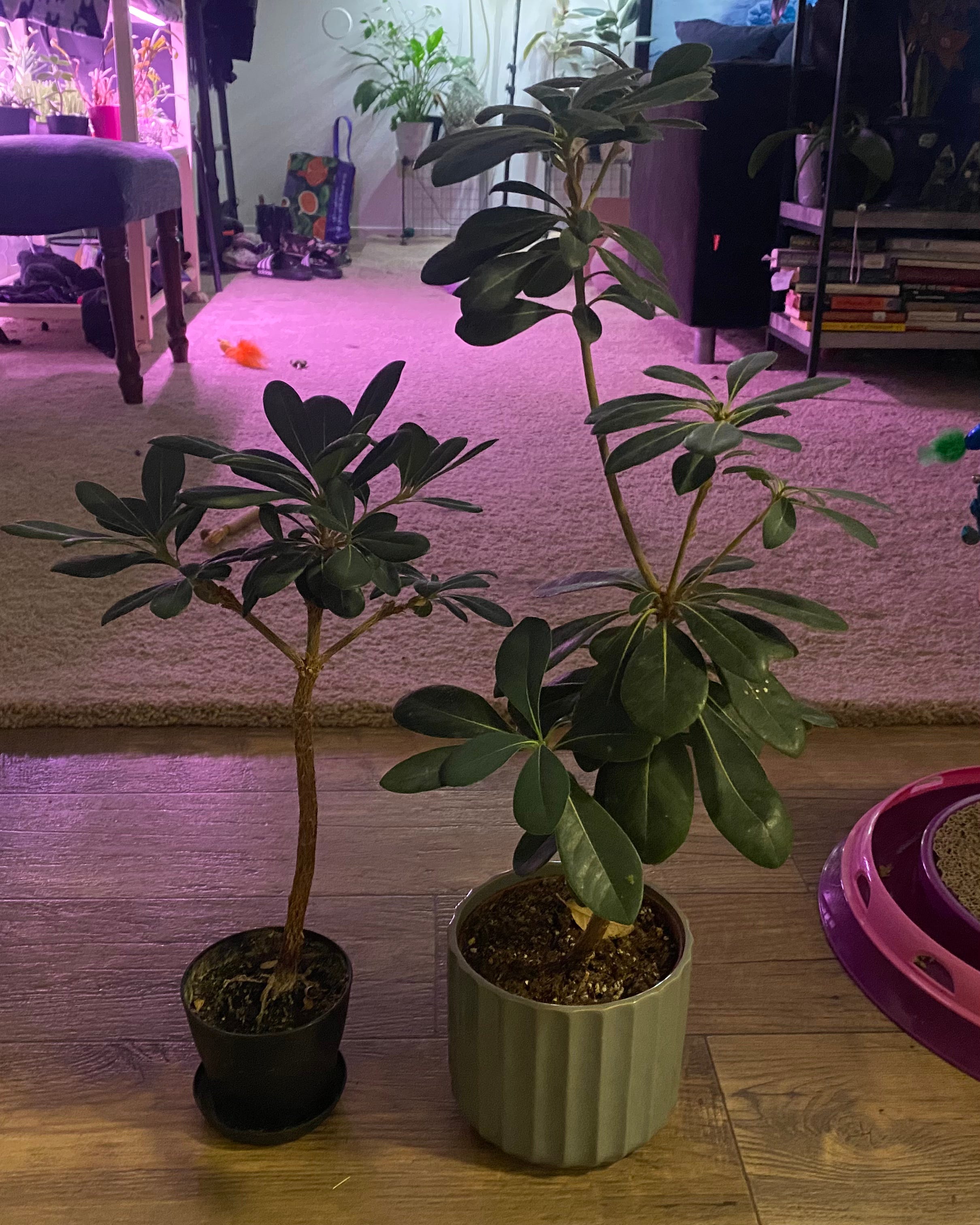
The tree I grew them from, as you can see (ok I forgot to take a picture), is variegated. I’ve been watching and it looks like new growth stays dark green for a while before it develops variegation, so it’ll be interesting to see if that happens to my baby plants or if they’ll just stay green. I’m happy either way, I love these guys. Mature trees bloom in early spring, so watch for seeds at the end of summer if you have one around you and want to grow your own. They are pretty popular landscape plants in the warmer parts of the world, so you just might.
Hey there! Here’s how plant horror in the coven works:
First week of the month - The Lab (that’s this post!) - Free for everyone.
Second week of the month - The Witch Lab (a short, horror piece from a plant witch’s journal detailing one of her experiences helping (I use the term loosely) a client using the featured plant of the month - New episodes are free! The back catalogue is going to remain paywalled largely because un-paywalling it is time consuming and I am busy doing horrifying things.
Third week of the month - The Grim Grimoire (an entry from The Witch’s spell book detailing how she uses this plant for her dark magic including spells, chants, recipes, instructions, and more). The text version of this will be free, but a digital zine version will go out to paid subscribers. The back catalogue will remain paywalled for the reason stated above.
Fourth week of the month - 100% Plant-Based Horror story featuring the month’s plant. These are longer stories that include everything from ghosts, to parasites, aliens, experimental supplements, monster trucks, extinct species, serial killers, and more! - Paid subscribers only, here’s a freebie you can read to check it out!
I used to simply pass by trees and leaves without a second glance, but thanks to this, I've had the opportunity to observe them more carefully. I shall look for them in Korea.
It was extremely beneficial.
*Incidentally, similar to the Japanese custom of scattering beans to ward off demons(鬼), Korea has a custom of scattering salt.